From what I have observed in the past, graduate students usually have their proposals tailored to their personal struggles, affiliated realities, research interests, or sometimes collaborative requirements with a professor. Personally, my responses to conference Calls for Proposals (CFPs) are usually based on the research ideas I have been preoccupied with, which often emerge from my personal encounters and realities as a diasporic African international student.
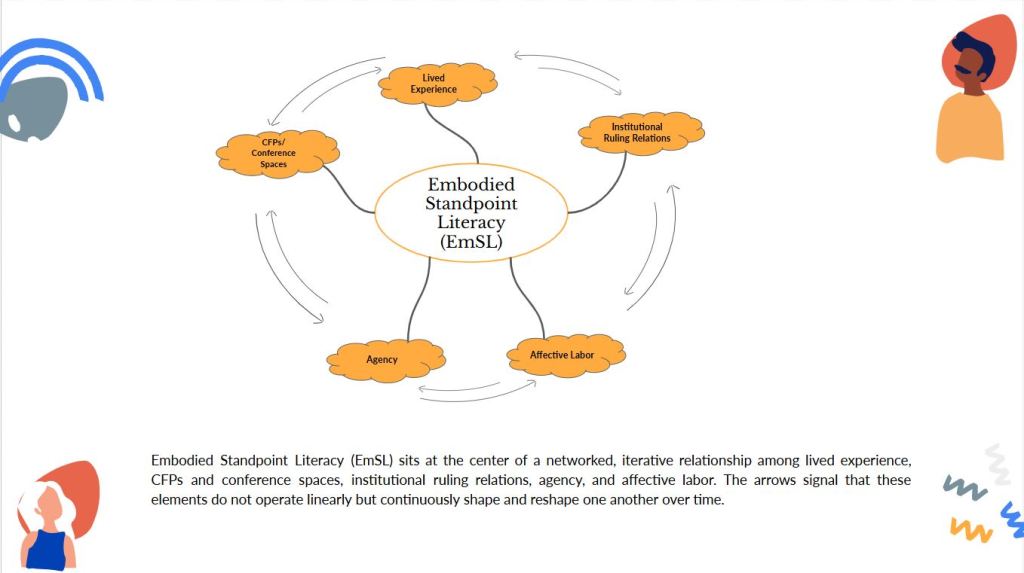
Over time, I have been particularly preoccupied with the idea of embodied standpoint literacy (EmSL), which argues that the ways we practice literacy, whether in writing, presenting, or participating in conferences, are shaped by our embodied realities and struggles. As an international student, my embodied standpoint deeply influences how I engage with scholarly conversations and how I frame my work within the broader academic discourse. Over the past couple of years, I have advocated for more inclusive, culturally responsive classroom spaces that acknowledge and value the diverse literacies and identities that students, especially those from underrepresented communities, bring with them. I am currently working on my dissertation, which examines how Anglophone African graduate students negotiate instructional documents and ruling relations at PWIs through their embodied standpoints. As an insider in this community, my own struggles prompted my interest in pursuing this research for a community I belong to and care about.
However, when it comes to conferences, the aims of these presentations often seem to end in the presentation room. Recommendations and prescriptions offered might never make it to the classrooms. In other words, as an international graduate student who experiences certain limitations and tailors my needs to conference CFPs, I find myself wondering what agential power we actually have beyond the recommendations we make in these spaces, and how our recommendations become actionable. It is not enough to book flights, travel long distances, engage in intellectual labor, network, and share perspectives, only to return to academic and professional spaces that remain unchanged. This cyclical pattern is demoralizing. It turns scholarly engagement into an embodied struggle, one that produces fatigue, frustration, and second-guessing about the value and impact of our work. And we all know that such embodied burdens are precisely what we do not need if we are to remain productive.
So my call to us all, as we make presentations, attend sessions, and engage in these spaces, is to think more carefully about our takeaways and to be more intentional about what we do with them. I believe that if each of us takes responsibility for translating conference insights into practice, our academic and professional spaces can become more responsive to students navigating institutional demands and their respective embodied standpoints.





 Tèmítọ́pẹ́ Ọ̀jẹ́délé-Adéjùmọ̀
Leave a comment