
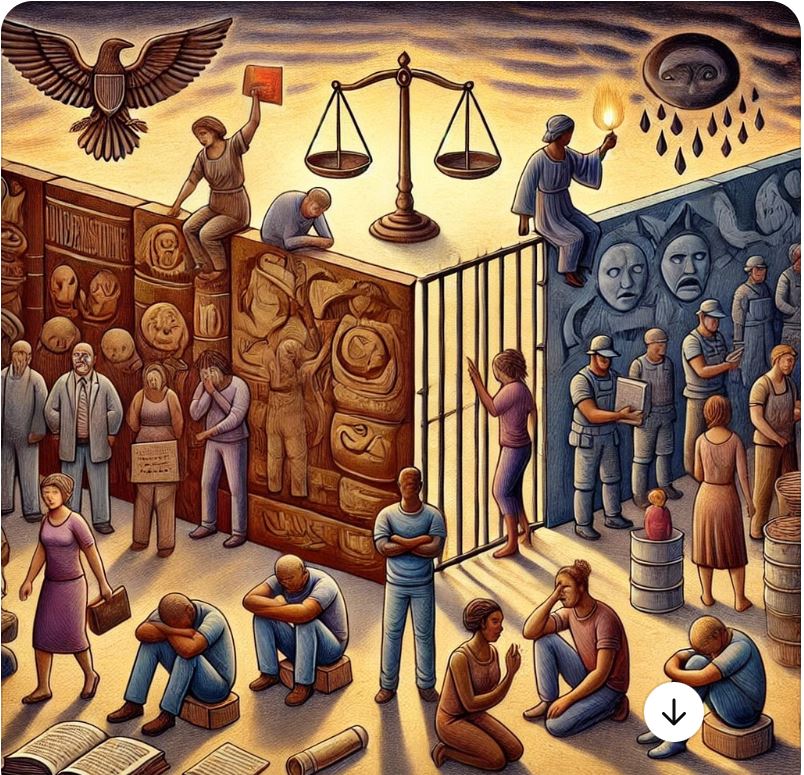
In my themed research class, students are typically required either to explore aspects of their disciplines that address societal problems by creating awareness, proposing solutions, or recommending better approaches, or to look beyond their disciplines to investigate cultural or personal issues. The research process usually begins with the Inquiry and Report, where students reflect on why they are pursuing a degree in their major. They may also examine alternative literacy issues that are not directly related to their field. Students are encouraged to consider the role their discipline plays in the world and the contributions they hope to make toward achieving a more just society.
Over the years, I have had to ask a few students to rewrite their essays because they clearly used AI to complete their work. However, when I read an essay, I do not judge whether it is AI-generated simply by looking for words that academics obsessed with the AI conversation have labeled as “AI words.” Instead, the real indicators are usually overly polished sentences, the naming of advanced concepts, and essays that are far removed from the proficiency levels I have observed in students’ in-class writing. For example, a student in Industrial Design completely neglected the purpose of the Inquiry assignment and wrote extensively about highly technical concepts in their field, concepts that were far too advanced for a freshman-level student. That was the real indicator. I called the student, and they admitted they had used AI. They were required to rewrite their project, and I also warned them about the University’s policy on the use of AI. In addition, I emphasized the ethical use of AI in class and explained that the rest of their research work must be originally produced by them. I stressed that the class is designed to measure imperfect processes toward more grounded intellectual production. That being said, this blog post is mainly about the growing obsession with so-called “AI words” and how students could be wrongfully accused of using AI simply because their essays include vocabulary that certain groups have marked as AI-generated.
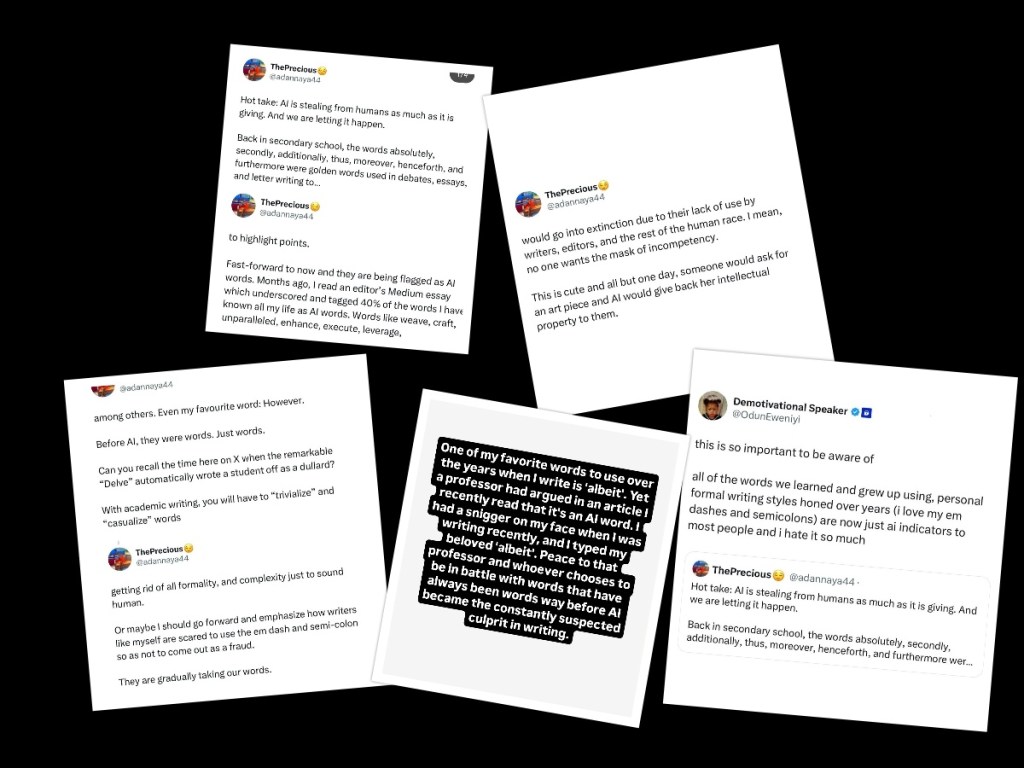
To categorize words that have always existed as “AI words” is what I have come to describe as the humanization of AI, where we credit things that belong to us as humans to AI. I recently came across a post on X that sparked various reactions about how words like “delve,” “however,” “absolutely,” “secondly,” “thus,” “moreover,” “furthermore,” “weave,” “craft,” “leverage,” “execute,” and “unparalleled” have been tagged as AI-generated. One commenter described this phenomenon as “AI stealing from humans” because humans have allowed or even orchestrated it.
Years ago, as an undergraduate student at the University of Lagos, all examinations were handwritten. You would receive your questions and an answer booklet where you wrote your responses. As an English and Literary Studies student, one thing I did consistently throughout my undergraduate and even master’s studies was writing, carefully weaving words I had learned over the years. One of the words I particularly loved using in my handwritten responses was “albeit.” Fast forward to 2024, I came across an online article where a professor argued that “albeit,” used as a connective, is an AI word. The same “albeit” I have used long before AI became widespread and all my essays were handwritten?
It is also interesting to note that what might be considered outdated among native speakers can still be widely used among non-native speakers of English. In Nigeria, for example, many people who have gone through formal education commonly use vocabulary that some might label as “big English.” Some of these expressions may be seen as outdated or overly refined, and with the current trend of arguments surrounding AI words, they could easily be mistaken as indicators of AI-generated writing, when this group of people are simply drawing from the linguistic traditions and formal education they have received over the years.
Beyond words, punctuation marks are not excluded either. In my English class in secondary school, the semicolon was taught as a necessary punctuation mark that helps provide more context to a preceding expression, introduce a list, or connect closely related ideas. In modern writing, however, and with the growing tension around AI indicators in writing, the semicolon is not spared. Writings that make use of semicolons and em dashes are increasingly being suspected as AI-generated.
My real concern is that in the unmeasured anxiety over AI, we risk losing our own humanity and all we have worked for over the years. I also worry that we may become careless in how we accuse students who are simply using words and punctuation they have learned and practiced over time, without any intention of appearing as pseudo-scholars. Most importantly, in this frenzied attempt to humanize writing, we risk losing the very words and punctuation that give our writing life, handing them over to AI, and paradoxically sounding more mechanical than ever because we continue to fear, suspect, and accuse what is actually ours.





 Tèmítọ́pẹ́ Ọ̀jẹ́délé-Adéjùmọ̀
Leave a comment