Framing the Conversation
In the contemporary academic landscape, the integration of personal experience and self-knowledge has given rise to self-expressive genres that blend lived experiences with scholarly discourse, reflecting a more nuanced approach to knowledge production (Bleich, 2003). A prominent self-writing genre in First Year Writing is Literacy Autobiography (LA) (Canagarajah, 2019), also known as literacy narrative (Yang, 2022).
Literacy Narratives as Contextual and Cultura
Designed to respond to modern pedagogical demands, literacy narrative has emerged as a valuable self-narrative tool for examining how students from diverse backgrounds develop and practice literacy in context-specific and unique ways (Carstens, 2012; Schmertz, 2018).
Structural Challenges in Curricular Design
However, the curricular design and expectations for the literacy narrative in our First-Year Writing classrooms are inherently textual and technological. The textual aspect of the project marks the first phase of the narrative, where students are expected to articulate their personal experiences with reading and writing using standard academic English. This phase emphasizes clarity, coherence, and organization, guiding students to reflect critically on their literacy journeys while aligning with dominant academic norms. Simultaneously, the technological component introduces students to multimodal composition tools, encouraging them to reimagine their narratives through digitally intensive designs that may include video, audio, images, or interactive platforms.
The Gatekeeping Effect
In other words, if a student is not equipped with proficiency in standard English and lacks technological literacy, a barrier to full participation and success in the assignment automatically emerges. This dual demand not only privileges certain forms of literacy over others but also risks marginalizing students whose linguistic and digital practices do not align with institutional expectations. As a result, what is framed as an open and personal narrative assignment can inadvertently become a gatekeeping exercise, reinforcing inequities tied to language access and digital resources.
Whose Literacy Matters
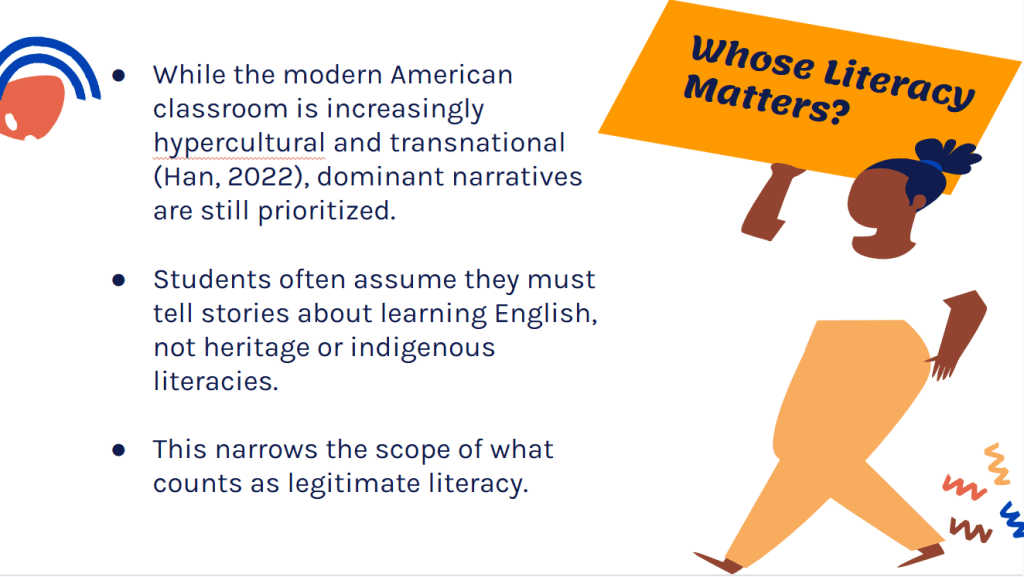
Also important is the question of what kinds of literacy stories we prioritize in our First-Year Writing classes. While the modern American classroom is increasingly hypercultural and transnational (Han, 2022), there remains an implicit expectation that communicates to students, often subconsciously, that certain narratives are more acceptable than others. When we ask students to journal or reflect on their literacy journeys, many assume they are expected to recount how they learned to read and write in English rather than in their indigenous or heritage languages. This traditional framing often marginalizes other forms of literacy development that fall outside the dominant narrative.
Think About It…
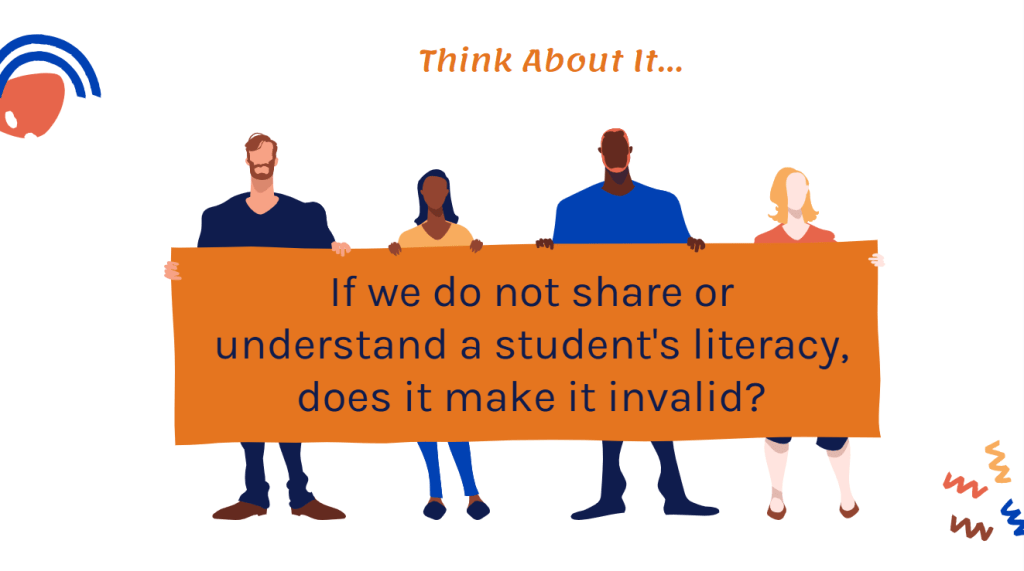
When we design projects in our writing classes, we must ask ourselves what expectations we are communicating to our students. I recall a student who visited the office I shared with a GTA to express concern about a First-Year Writing assignment. The instructor had encouraged students to explore American pop culture, but the student, whose literacy experiences were shaped by Korean pop culture, felt that their perspective was dismissed. The instructor’s feedback, as summarized to the student, focused on helping them find their way to understanding an American cultural perspective rather than encouraging them to explore or frame their project through their own cultural lens. In other words, if we do not belong to or understand a student’s form of literacy, does that make it invalid? If we fail to recognize and affirm diverse literacies, especially those shaped by transnational and cultural hybridity, we risk reinforcing a narrow definition of literacy that excludes the very students we aim to empower.
Introducing Alternative Literacy
As a First-Year Writing instructor, one way I have amplified disruption in the classroom is by introducing the concept of alternative literacy. In fact, at one point, I found myself exploring the idea of anti-literacy with one of my students. Alternative literacy helps us as instructors recognize that literacy is not a neutral or universal skill, but rather one that is reflective of an embodied standpoint shaped by culture, language, personal history, and institutional context. In other words, if we want the literacy narrative project to serve its intended purpose, we need to remain open to the diverse, disruptive, and remixed ways our students have come to understand and practice literacy.
Embracing Cultural Multimodality
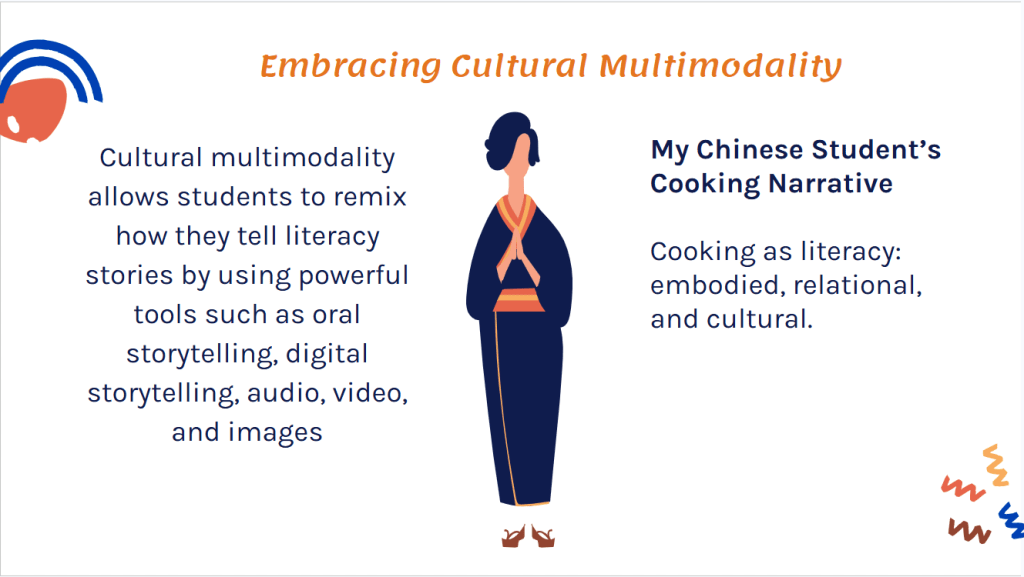
Embracing this perspective allows us to acknowledge the significance of cultural multimodality, which is not necessarily tied to traditional textual or technological expectations. One example of cultural multimodality that students can incorporate into their literacy narratives is the use of oral storytelling traditions combined with digital media. A student from a culture with a rich oral storytelling heritage might choose to create a video or audio recording of themselves sharing a story that has been passed down through generations in their family or community. This story could be directly connected to their literacy journey. To enhance the multimodal aspect of the project, the student could combine the audio or video recording with images, music, or animations that reflect their cultural background. For example, they might include photographs of family members, traditional artifacts, or landscapes from their homeland. They could also incorporate cultural symbols, patterns, or motifs into the design of their presentation.
In one of my literacy narrative classes, a Chinese student explored literacy through the cooking traditions passed down by the matriarchs in her family. Knowing how to make these traditional dishes was a vital expression of her identity within both her family and culture. While she presented her narrative through an infographic, a remixed version that might have captured more cultural essence could have been a mini-documentary involving the matriarchs of her family and the actual preparation of these dishes.
Why This Matters
By embracing cultural multimodality in this way, the student can create a literacy narrative that not only shows their academic writing and digital skills but also honors their cultural identity and the alternative literacies that have shaped their experiences. This approach allows for a more personal and meaningful exploration of literacy that moves beyond the confines of traditional academic discourse.
Questions for Reflection
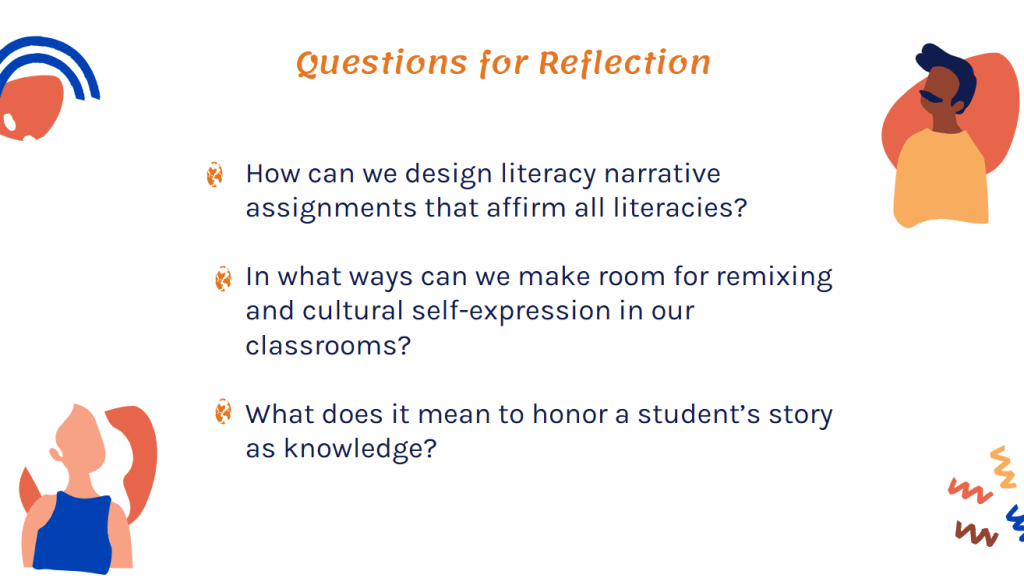
As writing instructors, we need to be intentional about designing literacy narrative assignments that validate all forms of literacy by allowing space for cultural self-expression and remixing. Honoring a student’s story as knowledge means recognizing lived experience as a legitimate and valuable form of learning.





 Tèmítọ́pẹ́ Ọ̀jẹ́délé-Adéjùmọ̀
Leave a comment