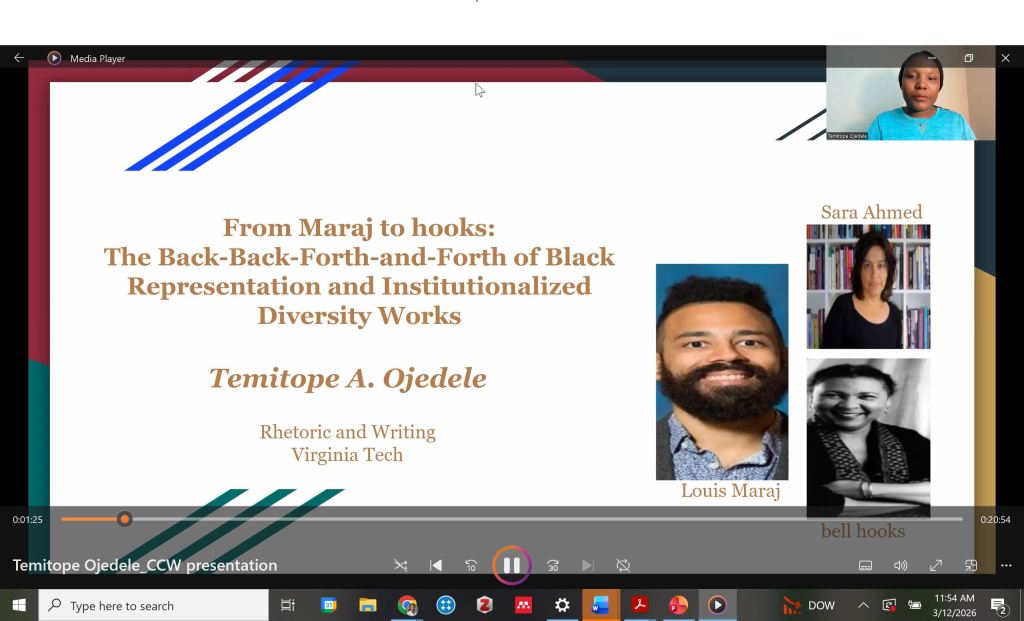
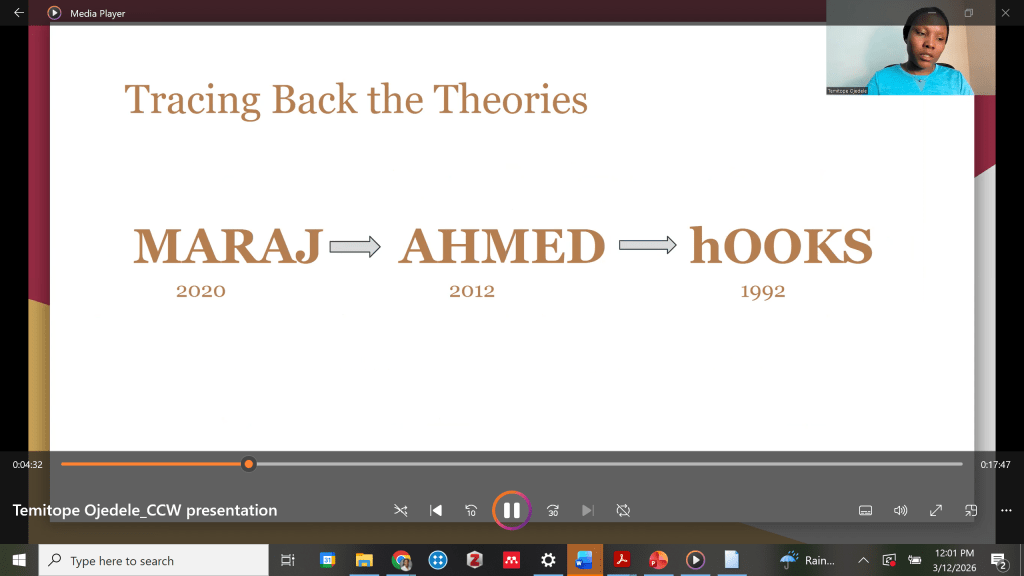
To write about the representation of Black people in its total sense is impossible. Studies on “Black representation” have been widely discussed under multiple concepts, including emerging ones, that are never enough to capture the whole essence of Blackness and the circumstances that surround its identity. Hence, the dialectics of the “representation of Blackness” in this paper would focus on selected, lucid concepts that emanate from Maraj’s Black or Right: Anti-Racist Campus Rhetorics (hereinafter referred to as Black or Right) and could be traced to Ahmed’s On Being Included: Racism and Diversity in Institutional Life (hereinafter referred to as On Being Included), and finally to hooks’ Black Looks: Race and Representation (hereinafter referred to as Black Looks). In the process of expounding on these concepts, however, references might be made to other related materials that are relevant to the argument.
Starting with Maraj, Black or Right is an addition to the “growing corpus of antiracist research” on Blackness in “white institutional spaces” (10). This statement limits our focus to “institutional spaces” as captured in temporal and geographical settings. In addition, it limits our argument on Black representation or Black identity vis-à-vis “institutional whiteness”.
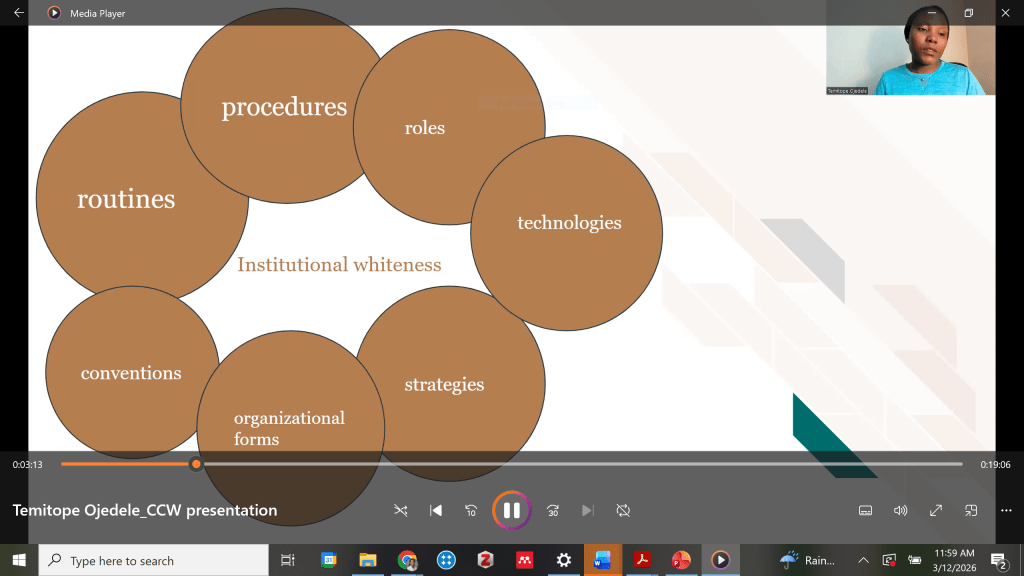
This “institutionalization” connects with Ahmed’s conceptualization of the term as an academic setting that is not independent of what happens in it in the forms of “routines, procedures, conventions, roles, strategies, organizational forms, and technologies” (21), but rather is a part of these processes that shape public perception. Maraj affirms his support for Ahmed’s argument on the non-performative attributes of “historically white institutions” (56). Ahmed cites hooks in her mantra of “eating the other” (69), and this points to an act of assimilation within an institution. hooks, however, do not solely restrict her semantic engagement to academic institutions, but “social institutions” (52) that, of course, involve academic.
The questions hereby develop from this establishment of the institution as an examining or existing space for black existentialism and socialization, thus:
- What are the institutionalized policies that influence the representation of Blackness?
- How does Blackness materialize in historically and predominantly white institutions?
- What are the survival tactics or intentional “wake work” (Sharpe, 2016, p. 18) Black people engage in to reinstate their worth in a dominant white space?
All of these questions will serve as frameworks to engage the concepts of marginalization, diversity, ethnography, activism, agency, assimilation, Black bodies, Black consciousness, communities, deviance, double consciousness, ecologies, home, white institutional defensiveness (neo-liberalism), positionality, space, and thingification.
It is important to note that some of these concepts, that are traced from Maraj down to hooks, are fluid and interconnected, such that expounding on the conceptualization of one is to refer to the functionality of another.
Maraj and Ahmed on Marginalization and Diversity
Maraj’s discussion of diversity is a continuous echo of Ahmed’s argument in On Being Included. It is premised on how Ahmed analyzes diversity documents, how they are used, and what they are used for—an exposure she gets from working as a diversity officer and finding herself in the spaces of diversity and how it is being wrongly represented in “people, documents, and events” (Maraj, 2020, 16). Maraj emphasizes that his book engages Ahmed’s approach as a foundational directive for “multisited-ness”. Coined by anthropologist George Marcus in 1995, “multisited ethnography” involves engaging subjects or objects based on their levels of differences and cultural complexities (Marcus, 1995). Maraj extends this denotation to Black presence in institutions vis-à-vis the deficiencies of engaging them as defined by dominating white policies. In other words, to adopt the term “diversity” in commitment statements as an institution is to be practical about ways of engagement that truly portray the willingness to diversify.
Citing situations from Midwestern State University (MwSU), Maraj looks back on Ahmed’s argument about “perception data,” which is an approach used to achieve white institutional defensiveness. Ahmed argues that diversity is portrayed to the public more as a way for the school to generate the right image—a mantra of belongingness to the utopian equity society wants—with no efforts whatsoever in actually dealing with the issues of diversity. This defensiveness, according to Ahmed, is “changing perceptions of whiteness” in a historically white institution “rather than changing the whiteness of organizations” (Ahmed, 2012, p. 34). It is the happy story institutions want to be found in their policies alongside the reality bared through the process of anonymity. It is equity in policy on websites and prints versus equity in action, the absence of performativity. What are the realities inherent in the “whiteness” of an academic organization? In response to this question, Maraj writes extensively on marginalization and black bodies (criminalized embodiments).
Hinged on Ahmed’s institutional paradoxism, which is the institutional recognition and commitment to racialization cloaked in persisting inertia, Maraj cites vivid examples of events in MwSU that reestablish the faux existence of diversity, as it should be, in an institution that uses the term at every opportunity. One of such events is the gathering of students of color to protest marginalization in the historical white system, a necessary call for the institution to
“Transform their contemporaneous university spaces” (Maraj, 2020, p. 107). “Spaces” here refers to physical ecosystems, instructional contents (syllabus), stereotyping, and other institutionalized racist situations. If the institution truly wants a change rather than a face, it is to admit their errors and work on this change, but a protest from these students on these dehumanizing issues is seen as “disruptive” and “threatening” (Maraj, 2020, p. 109). What do they want to disrupt? What status quo are they threatening? The protests of these students resonate with Bey’s conceptualization of problems. The students become a problem for the school because they have decided to problematize (Bey, 2020) what the institution has glossed up as normal. In order to maintain this unruffled tranquility that the institution has wound up in the overt designation of “diversity”, the problems would have to go. This, according to Maraj, the school intends to achieve through “arrest” and “expulsion” (109).
Maraj sees a poster that calls for people to join “us” (102) in his off-campus neighborhood. “Us” could have been a harmless, weightless, subjective plural pronoun that simply denotes collectiveness, belongingness, and solidarity towards a course. However, in an environment where, as a black person, you constantly feel “out of place”, like “the one who does not belong”, the one “whose proximity is registered as a crime or threat,” and a “stranger” in the only place you could call “home” (Ahmed, 2020, p. 2), there is an automatic, self-conscious problematization of that collective denotation of “us”: “Who is the us?” (Maraj, 2020, p. 102). The institution is constantly suffused in a dialectical tension of wanting a black person in its environment as necessitated by social constructions or expectations, yet it does not want that black person in its business. In a social context of hospitality, the visitor is usually asked to “feel at home” when both the visitor and the host are aware of boundaries not to cross; the host’s house is never a “home” to the visitor and would never be.
Marginalization, Maraj posits further, plays out in black embodiment, stereotyping, and categorization. It is the question of what the black body or presence represents in a white institution. Maraj establishes that blackness, in a white institution, represents criminality, threat, concern, and the inability to be law-abiding. It is a resonating symbol, an intruding problem that has to be put in check and kept to ensure the safety of the “host”. The knowledge of the black person as a threat, according to Browne, is what necessitates discriminatory treatments institutionalized in policies and practices (Maraj, 2020, p. 111). Clothing is an extension of white institutions’ representation of blackness. Selected clothing, hairstyles, body markings, etc., serve as marginalizing and categorizing yardsticks to define a black person regardless of who they are.
This categorization echoes Sharpe’s argument on ungendering or gender nihilation of the black person (Sharpe, 2016, p. 77). The representation of blackness does not see beyond the criminalized, intruder tags; either the black person is old or young, male or female. This attribute connects with the thingification of blackness.
As a diversity worker in an institution, Ahmed captures the thingification of a black person working in that capacity. She posits that as a diversity worker, you are part of the objects needed to further polish the public perception of the university as actually working on truly making the institution diverse in the performative sense of it. It is the objectification of black embodiment, almost ornamental. In other words, the diversity worker of color is like a flower in a vase needed to make the interior as beautiful as the exterior has suggested; it is, however, a more unfortunate situation because it is a plastic flower than a real one because the institution is not interested in watering it to sustain it. Ahmed describes the appointment as being “just there” with no institutional support (Ahmed, 2020, p. 23). She further argues that the presence of a diversity worker is an act of white institutional defensiveness—a neoliberalist cover-up for the
absence of intentional, performative policies that are aimed at achieving diversity and inclusiveness—one that makes a student of color feel at home in the only place they could call home.
Hooks and Diversity as an Appealing Ad Tool
As earlier established, Hooks engagement of black representation in Black Looks is not solely from an academic angle, which is a framework that is more resonated in her Teaching to Transgress. Institutionalization in Black Looks is racialization on all levels. However, Ahmed cites hooks while she argues on how diversity plays out or is used as a propaganda tool in institutions (Ahmed, 2020, p. 69). Hence, moving on to Hooks’ contextualization of diversity in her text, she establishes a background that engages “diversity” as a manipulative tool. Quoting from Cone’s A Black Theology of Liberation, Hooks asserts that recurrent racialization, which necessitated the need for the diversity mantra in the first place, is an aftereffect of an existential reality founded “for whites… from the white perspective” (Hooks, 2015, p. 11). To call for an end to this whiteness is to “destroy” it, which is similar to Wilderson’s pessimist view on black people’s future, with the only solution being “the end of the world.” “a total end to things—an apocalypse” (Cunningham, 2020).
With the problem recognized alongside the impossible eradication of racism, Hooks posits that the use of “diversity” is political, one that is intended to cover up a crack that would always be noticed. She describes it as a “spice that can liven up the dull dish that is mainstream white culture” (Hooks, 2015, p. 14). Hence, because it is a façade, it cannot materialize in practice; rather, it becomes a rhetorical tool to persuade and establish an “everything is going tobe alright” feeling. Its materializing space, therefore, remains in a place of words rather than practice—advertisement.
For it is the ever-present reality of racist domination and white supremacy that renders problematic the desire of white people to have contact with others. Often, it is this reality that is most masked when representations of contact between white and non-white, white and black, appear in mass culture. One area where the politics of diversity and its concomitant insistence on inclusive representation have had a serious impact is advertising. (Hooks, 2015, p. 28)
Ahmed’s institutional paradox is illustrated in “we are committed to,” which usually precedes the diversity statement on most institutions’ sites. But it, most times, only ends there; commitment is after all in practice and not mere words. Maraj recalls the event organized by the Department of Public Safety at MwSU, saying, “In its publicity material, the department stresses its commitment to “diversity.” (108). He, however, further enacts a conflicting graphic presence in the publicity that suggests the negative categorization of black people as people of crime. Hooks contends that the white institution’s desire to be identified with an act of homogeneity is to enhance their status, as Rutherford in “A Place Called Home: Identity and the Cultural Politics of Difference” captures in an economic term as “cultural difference sells” (hooks, 2015, p. 17).
Surviving an Unending Cycling Reoccurrence
Sharpe in In the Wake: Blackness and Being writes about black reality in a white space as “an ongoing problem” (14), which the likes of Wilderson, Cone, and Bey believe will not come to an end unless there is an apocalyptic eruption that reinvents the whole ontological (political ontology) arrangement of things. The question is: Would this eruption ever happen? It does not look like it; its possibility seems to end in its theorization. If it does not end, then where do black people go from here? Or it seems to me like the journey already started (in the context of this paper) with Hooks, Ahmed, and Maraj, with their suggestions of the following:
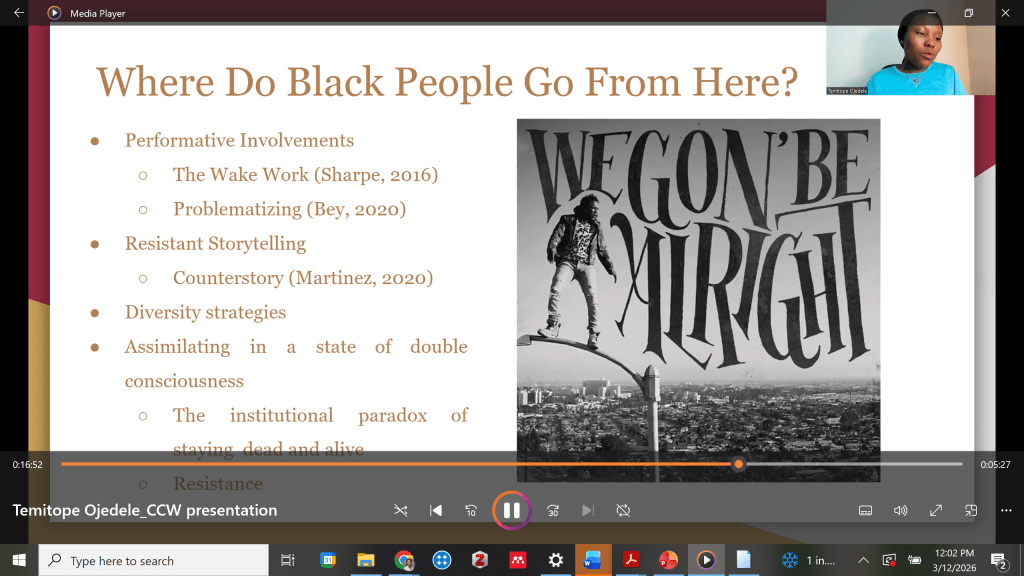
Performative Involvements
Maraj explicates how a student, T, makes him more conscious of his embodiment of his blackness in a white space (place, time, circumstances); an interrogation that makes him more intentional about convincing people like him, who are in similar black struggles, to be able to understand that he sees them just as they need to see him. Surviving institutionalized racism requires being involved—what Sharpe describes as “wake work” (Sharpe, 2016) and what Bey describes as “problematizing” (Bey, 2020).
To be involved in problematizing white supremacy in institutions, according to Maraj, is to gaze (measure, assess, understand, be a part of) and talk back (act) (p. 42). One of such ways of “talking back” is through “resistant storytelling” (p. 43), embodied in the methodology of counterstory with autoethnography as its method. Quoting Adams, Jones, and Ellis (2015), Maraj throws out a comrade call: “I call on autoethnographers and nonauthoethnographers ‘to consider the accessibility of their texts, asking what value or benefit our work might have for our participants and readers, as well as ourselves’” (p. 42).
Similarly, Ahmed sees diversity inaction in institutions as a methodology problem that could be solved not only by talking to people about it but by being a participant in activities that help reinstate diversity in the act of it; to be “both an insider and outsider” (see it from other people’s views (outside) and from your own participatory view) (p. 12). One of such ways of participating is by belonging to a group that projects that vision (p. 13). Using what she describes as “diversity strategies” (p. 32), performative involvement could necessitate unblocking institutional, racially defined “blockages”. To give credence to diversity, as a diversity worker, is to first recognize the lapses and ways to overcome them (p. 29), publicize the problem and the problem-solving suggestions through circulation (p. 30), which would help foster getting and redirecting institutional attention, and have diversity people (those genuinely interested in diversity) be in key places in order to institutionalize diversity and make it a norm (p. 31). Those who are capable of doing diversity work are those who are willing to constantly be on their feet.
Assimilating in a State of Double Consciousness
Maraj resonates Du Bois’s concept of double consciousness when he interrogates the continual identity struggle of the black person in a systemic white institution—the timed, situational affiliation with one over the other (p. 86). Ahmed similarly sets her background on the notion of not being at home in one’s home, a state of tension that makes it difficult for a black person to identify with a particular identity obligation (pp. 2–3). Hooks encapsulates this in her chapter on “Eating the Other”: the pull-push dilemma between “desire and resistance” (p. 21). All of these discussions reinforce the following questions: What does the black person desire? What do they have to contend against? How does their humanity remain intact while they contend?
Maraj articulates the desire as “being simultaneously dead to white institutional power…while very much alive in one’s blackness” (p. 87). For Ahmed, it is to feel at home, to actually be seen in her state of diversification, and to be respected for her differences, hence her preoccupation with what “diversity” could do for her and people like her. These desires are constantly contending against a white system that criminalizes the black person’s attempt to achieve them. Hence, in order for the black person to keep clearing a path that leads to the actualization of these desires, they have to assimilate.
Using Kendrick Lamar’s “Alright”, Maraj engages in ways of using the tools in the white system to project black narratives (p. 86). He analyzes the dichotomy of death and life (wake). If the white system sees it as “dead”, the black person should see it as an opportunity to navigate awakeness. This extends to Sharpe’s multifaceted and paradoxical interpretation of “wake” in the states of death and life (consciousness). The repeated verse “we gon be alright” in Lamar’s “Alright” rhymes with the standard English expression “gone” (to lose, to be lost, to die), yet it functions in Lamar’s lyrics (“gon”) as a symbol of “hope” and life (p. 90). “Wake” in contemporary black colloquialism also translates as “woke”, which means to be conscious of systemic manipulations and fight against them.
Assimilating, for Ahmed, is to make good use of opportunities presented by the white system to project the black person’s desires and circulate them in their meetings, using their resources in their space. To be constantly moving and “doing” within that space. For Ahmed to do the diversity work, he must adopt Hooks’ “eating the other” (p. 69), which Hooks reinstates as “a challenge to white supremacy, to various systems of domination” (p. 39). This reverberates in what Maraj conceptualizes in activism, hash-tagging, and deviance: a conscious “rhetorical reclamation” that “publicly question[s] or critiques [systemic white institutions’] power in moments of fracture” (p. 20).
Conclusion
In engaging Maraj, Ahmed, and Hooks, alongside other critical analysts of black representation, it is established that:
- The representation of blackness in a white system is problematic.
- White institutions do not overtly admit that there is something wrong with or in the system.
- Racism is easily normalized because of the historicity of whiteness, on which other representations are formed.
- A utopian, equal, or equity society is almost impossible.
- Black people must be actively up and doing to own their identities, and they have to do it right.
- Assimilation could operate outside of neo-colonialism; it is adapting to new ecologies founded on one’s desires.





 Tèmítọ́pẹ́ Ọ̀jẹ́délé-Adéjùmọ̀
Leave a comment